Analysing a phishing email
I've been hit by several phishing emails in a short time the last week. Having time this morning I took the initiative to look at the headers from one email and the phishing location.The hosting server
The domains DNS zone is hosted on a particular network just like its website. Two different servers actually, but behind it seems to be a lucrative webhosting service where you can get your domain registered although it's not a registrar. All of this is hosted in Texas.
The email server
The email is originating from Italy. The FROM address is set up to show a truthful email (usually where you put the surname) with an inexistant email address behind that. The email address' domain name exists however and is hosted in France, but has no relation to the scam, at least the owner of this domain can't do anything about it.
The Return-Path shows a real email address with a different domain name but same network anyway. The domain name shows a dummy webpage "Under construction".
Who to contact?
All of them if you care, otherwise just let it go, because phishing pages are set up and down daily...
To contact the webhosting or email server, request the Whois information of the IP address and contact the abuse department, there is always an abuse section in the Whois of an IP address. You can also contact the domain name holder and/or look if the registrar or webhosting sevice has a dedicated abuse website page.
Of course it happens that an abuse email address forwards everything to the trash can. In order to have a chance to stop the scam, it is good to contact as many services as possible.
Analysing a phishing email
I've been hit by several phishing emails in a short time the last week. Having time this morning I took the initiative to look at the headers from one email and the phishing location.The hosting server
The domains DNS zone is hosted on a particular network just like its website. Two different servers actually, but behind it seems to be a lucrative webhosting service where you can get your domain registered although it's not a registrar. All of this is hosted in Texas.
The email server
The email is originating from Italy. The FROM address is set up to show a truthful email (usually where you put the surname) with an inexistant email address behind that. The email address' domain name exists however and is hosted in France, but has no relation to the scam, at least the owner of this domain can't do anything about it.
The Return-Path shows a real email address with a different domain name but same network anyway. The domain name shows a dummy webpage "Under construction".
Who to contact?
All of them if you care, otherwise just let it go, because phishing pages are set up and down daily...
To contact the webhosting or email server, request the Whois information of the IP address and contact the abuse department, there is always an abuse section in the Whois of an IP address. You can also contact the domain name holder and/or look if the registrar or webhosting sevice has a dedicated abuse website page.
Of course it happens that an abuse email address forwards everything to the trash can. In order to have a chance to stop the scam, it is good to contact as many services as possible.
Irrational behaviour
So, I want a new phone. I really don’t need one, but I want it anyway.
This is my current phone:

And it fits my needs perfectly: water/dust/sand(!)-proof — Leonie and Guido are 3 and 1 year old now, so this is not a useless feature at all ;-) Moreover, it lasts two weeks without recharging and I only use it to make phone calls, so I don’t need anything with more features.
Still, I want this phone:

Basically, I’ve fallen for the pretty pcitures and UI demos, but I tell myself it is because it runs “real” linux.
What’s wrong with me? ;-)
Xfce Design SIG launches
As Jérôme Guelfucci wrote in his blog earlier, a special interest group has been started. The Xfce Design Special Interest Group (or SIG) has a clear purpose (quote from the groups wikipage):
The Xfce Design SIG aims at improving the usability and visual appearance of the Xfce desktop environment. Our goal is to bring interested users, designers and hackers together to ensure neither of them is working in a vacuum. By establishing a context in which they can collaborate on smaller and larger design-related projects we try to increase the chance of the proposed changes to be merged into the official Xfce repositories.
I’m looking forward to working with Xfce directly and more closely after working years with Xubuntu. It’s both easier for us and assures that all Xfce users can enjoy the improvements, not just those who use Xubuntu.
Are you interested specially about Xfce Design? Join us!
Xfce Design Special Interest Group
A special interest group was recently started to improve the usability and visual appearance of the Xfce desktop environment. It is defined on the Xfce wiki as follows:
The Xfce Design SIG aims at improving the usability and visual appearance of the Xfce desktop environment. Our goal is to bring interested users, designers and hackers together to ensure neither of them is working in a vacuum. By establishing a context in which they can collaborate on smaller and larger design-related projects we try to increase the chance of the proposed changes to be merged into the official Xfce repositories.
Everyone is of course welcome to join this group which has already started working on several points and producing very interesting elements! I'll introduce here two of the main projects we are currently working on for Xfce 4.10. But more will follow soon!
I would like to thank Simon Steinbeiß and Pasi Lallinaho from the Shimmer Project who played a crucial role in starting this SIG.
Thunar shortcuts pane rework
You can see what is being proposed on this page. The main goals are to reduce the visual clutter in the shortcuts pane by sorting items in different categories and to integrate nicely remote file systems (Samba, FTP...) which are supported since Thunar 1.2.0. The current demo we have looks like this:
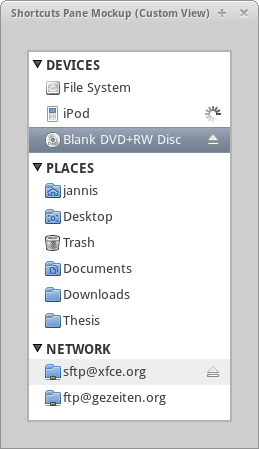
I encourage you to have a look at the Wiki page linked above, which contains a very accurate description of what we want to achieve and how we are going to achieve it.
Merge of xfrun and xfce4-appfinder
You can see what is being proposed on this page. The goal is to produce a single interface allowing to quickly launch applications and to perform actions. We plan add an extension system similar to the Thunar Custom Actions to allow the creation of a tailor-made interface.
This is of course still work in progress, but this is how the two main view currently look. Clicking on the arrow on the right hand-side of the entry switches from one view to the other.

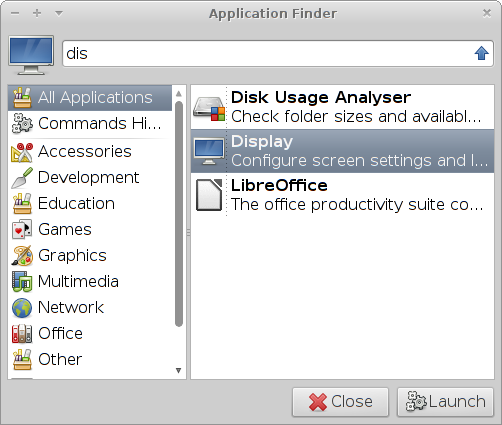
I encourage you to have a look at the Wiki page linked above, which contains a very accurate description of what we want to achieve and how we are going to achieve it.
Don't worry!
We already received some mails and comments asking whether it meant that we would move towards a Gnome 3 interface. The goal is not (yet :D) to bring a revolution but rather to streamline what we currently have by improving the numerous rough edges. Of course, we might take some inspiration in other desktop environment but we will not copy what is done in Gnome 3 or KDE4, Xfce has its own philosophy which is serving its users well at the moment.
Useful links
Changing PolicyKit settings per user
I have been hit twice by a required authentication on my workstation after the Wifi connection got lost and it is clearly irritating, especially when you are not around. The authentication requests are handled by PolicyKit (polkit for short) and can be tweaked.The message by which I was hit was the following: "System policy prevents modification of network settings for all users."
Before you get started, the system wide configuration files that contain the default values reside inside the /usr/share/polkit-1/actions/ directory. In this directory resides the file org.freedesktop.NetworkManager.policy which contains all the default actions. It does also contain the message about the network settings for which the action id is "org.freedesktop.NetworkManager.settings.modify.system." At this point I was still clueless of what I was supposed to do.
After having search the web for information about PolicyKit I have found one interesting article that helped me getting done with my issue and learning more about this authorization framework. This action being very seldom to perform, I'm summing up everything here.
There are two useful commands to perform tests with PolicyKit, pkcheck and pkaction.
The first interesting command to use is pkcheck. It will trigger an authorization request and prompt you to type in a password, simply return true if no authorization is required otherwise false. For example:
pkcheck --action-id org.freedesktop.NetworkManager.settings.modify.systemYou have to adapt the process and user parameters of course.
--process `pidof gnome-session` -u `id -u`

Next the command pkaction can be used to print the default system values, for example:
pkaction --action-id org.freedesktop.NetworkManager.settings.modify.systemNow to have a custom setting for your user, what has to be done is to create a PolicyKit Local Authority file inside the directory /var/lib/polkit-1/localauthority/. Here is an example:
--verbose
[Let user mike modify system settings for network]I have saved this file under /var/lib/polkit-1/localauthority/50-local.d/10-network-manager.pkla.
Identity=unix-user:mike
Action=org.freedesktop.NetworkManager.settings.modify.system
ResultAny=no
ResultInactive=no
ResultActive=yes
There are three main values you can pass to ResultActive that are no, auth_admin or yes. Respectively it will deny the authorization, ask for a password, and give access. For further information about the possible values check the polkit manpage, also don't miss the pklocalauthority manpage to read more about the localauthority tree structure.
Changing PolicyKit settings per user
I have been hit twice by a required authentication on my workstation after the Wifi connection got lost and it is clearly irritating, especially when you are not around. The authentication requests are handled by PolicyKit (polkit for short) and can be tweaked.The message by which I was hit was the following: "System policy prevents modification of network settings for all users."
Before you get started, the system wide configuration files that contain the default values reside inside the /usr/share/polkit-1/actions/ directory. In this directory resides the file org.freedesktop.NetworkManager.policy which contains all the default actions. It does also contain the message about the network settings for which the action id is "org.freedesktop.NetworkManager.settings.modify.system." At this point I was still clueless of what I was supposed to do.
After having search the web for information about PolicyKit I have found one interesting article that helped me getting done with my issue and learning more about this authorization framework. This action being very seldom to perform, I'm summing up everything here.
There are two useful commands to perform tests with PolicyKit, pkcheck and pkaction.
The first interesting command to use is pkcheck. It will trigger an authorization request and prompt you to type in a password, simply return true if no authorization is required otherwise false. For example:
pkcheck --action-id org.freedesktop.NetworkManager.settings.modify.system \You have to adapt the process and user parameters of course.
--process `pidof gnome-session` -u `id -u`
Next the command pkaction can be used to print the default system values, for example:
pkaction --action-id org.freedesktop.NetworkManager.settings.modify.system \Now to have a custom setting for your user, what has to be done is to create a PolicyKit Local Authority file inside the directory /var/lib/polkit-1/localauthority/. Here is an example:
--verbose
[Let user mike modify system settings for network]I have saved this file under /var/lib/polkit-1/localauthority/50-local.d/10-network-manager.pkla.
Identity=unix-user:mike
Action=org.freedesktop.NetworkManager.settings.modify.system
ResultAny=no
ResultInactive=no
ResultActive=yes
There are three main values you can pass to ResultActive that are no, auth_admin or yes. Respectively it will deny the authorization, ask for a password, and give access. For further information about the possible values check the polkit manpage, also don't miss the pklocalauthority manpage to read more about the localauthority tree structure.

Changing PolicyKit settings per user
I have been hit twice by a required authentication on my workstation after the Wifi connection got lost and it is clearly irritating, especially when you are not around. The authentication requests are handled by PolicyKit (polkit for short) and can be tweaked.The message by which I was hit was the following: "System policy prevents modification of network settings for all users."
Before you get started, the system wide configuration files that contain the default values reside inside the /usr/share/polkit-1/actions/ directory. In this directory resides the file org.freedesktop.NetworkManager.policy which contains all the default actions. It does also contain the message about the network settings for which the action id is "org.freedesktop.NetworkManager.settings.modify.system." At this point I was still clueless of what I was supposed to do.
After having search the web for information about PolicyKit I have found one interesting article that helped me getting done with my issue and learning more about this authorization framework. This action being very seldom to perform, I'm summing up everything here.
There are two useful commands to perform tests with PolicyKit, pkcheck and pkaction.
The first interesting command to use is pkcheck. It will trigger an authorization request and prompt you to type in a password, simply return true if no authorization is required otherwise false. For example:
pkcheck --action-id org.freedesktop.NetworkManager.settings.modify.system \You have to adapt the process and user parameters of course.
--process `pidof gnome-session` -u `id -u`
Next the command pkaction can be used to print the default system values, for example:
pkaction --action-id org.freedesktop.NetworkManager.settings.modify.system \Now to have a custom setting for your user, what has to be done is to create a PolicyKit Local Authority file inside the directory /var/lib/polkit-1/localauthority/. Here is an example:
--verbose
[Let user mike modify system settings for network]I have saved this file under /var/lib/polkit-1/localauthority/50-local.d/10-network-manager.pkla.
Identity=unix-user:mike
Action=org.freedesktop.NetworkManager.settings.modify.system
ResultAny=no
ResultInactive=no
ResultActive=yes
There are three main values you can pass to ResultActive that are no, auth_admin or yes. Respectively it will deny the authorization, ask for a password, and give access. For further information about the possible values check the polkit manpage, also don't miss the pklocalauthority manpage to read more about the localauthority tree structure.
How to fix broken Xubuntu Natty panels?
Since many people have had problems with the Xubuntu Natty panels due to bug #747137 (which is fixed now), we thought it would be nice to tell how to fix the panels. Here goes:
- Log out from Xfce
- Open a TTY (eg. press Ctrl+Alt+F1)
- Log in in the TTY
- Run ‘rm -rf $HOME/.config/xfce4/xfconf/xfce-perchannel-xml/xfce4-panel.xml’
- Log out from the TTH (‘logout’ should do the trick)
- Get back to TTY7 (Ctrl+Alt+F7) or if that doesn’t work, TTY8 (Ctrl+Alt+F8)
- Log in and your panels should be now fixed and have the default settings
Note that this problem with the panels only appears on systems already running Natty, new installs shouldn’t be affected.
important strategic decisions
Posting our recent decisions for Foresight Linux as sent to the mailing list by doniphon:With the ongoing mess with the gtk2 -> gtk3 migration, followed by
the announcement of the gnome reschedule, and the gnome-shell/unity
rift, we do think our 2 major desktops gnome and xfce are rendered
unusable for the unforeseeable future. Same counts for kde as nokia
started to drop support for qt. Therefore we decided to focus our work
on getting in e19, a major enhancement to enlightements e17, using an
improved and hw accelerated curses library, done by us on a still
private bitbucket repository. This change also involves getting rid of
the much hated combination of pulseaudio/alsa in favour of the much more
modern and stable OSS 4.2, and entirely dropping Xorg and evolving to
Xfree2k. We're looking foreward to provide a superior user experience
soon with fl:3++. We'll shortly set the e19 repository to public, so you
all can benefit (and contribute) after signing our standard contribution
agreement that cedes all your present and future rights to Paris Hilton.
As a side note we'll be moving our default kernel to MinixNG too.
Have a nice day.
Porto, 1th April 2011
The Foresight Linux Council
